
Countertop refinishing works by rebuilding the surface in place: the counter is deeply cleaned, its damage repaired first, the surface mechanically prepared for bonding, and a durable coating built in controlled coats, curing for 24 hours after the final coat before the kitchen returns to service. Every step serves the bond and the flatness a counter’s raking light will judge forever. Here is the sequence in order, why each stage exists, and what a properly run counter day looks like from your side of the kitchen.
Step One: Photos and the Material Read
Counters start where every renewal starts, with photos: the full run from standing height, the worst damage close, the sink area, and an edge shot if the material is ambiguous. The reply names the material, laminate, cultured marble, solid surface, or tile, flags anything structural, and prices the actual project. The materials map behind that read is at what countertops can be refinished.
Step Two: Masking the Kitchen
Counters touch everything: cabinets below, backsplash behind, appliances beside, floors underneath, and the sink and faucet in the middle. All of it is masked and sealed before chemistry opens, with ventilation set up and managed by the crew for the duration. A counter project should leave one change in the kitchen, and the masking is where that promise is kept.
Step Three: Degreasing a Kitchen Surface
No surface in the house carries more film than a kitchen counter: cooking grease, cleaning-product residue, silicone from years of polishes, all invisible and all coating repellent. Industrial degreasing and deliberate silicone treatment remove what the daily wipe-down never did, because the coating bonds to whatever it actually meets, and this step decides what that is.
Step Four: Repairs Before Coating
- Chips and gouges filled and rebuilt flush to the surface plane
- Burn damage ground out and rebuilt rather than hidden
- Worn and lifted edges stabilized and rebuilt where they qualify
- Any previous coating stripped completely off
Counters punish skipped repairs faster than tubs do, because raking window light finds every telegraphed flaw in a flat plane. Damage rebuilt to flush disappears; damage coated over becomes a shadow the kitchen reads every morning. The damage-specific chapter is at refinishing stained and damaged countertops.
Step Five: Mechanical Preparation
The old surface, glossy or worn, is prepared into a bonding profile the new coating keys into, the counter version of the etch every renewal on this site depends on. It is invisible in the after photos and responsible for the finish still being a finish in year eight.
Step Six: The Coating, Built Flat
The finish goes on in controlled coats, building to a smooth, uniform surface in the color and look chosen at the quote. Under our 24-Hour Spa Shell Transformation Method the transformation completes inside a 24 hour work window, and on counters the craft discipline is flatness: even coats, managed edges, and a surface that reads level under the hardest light in the house.
Step Seven: The 24 Hour Cure
The finish cures for 24 hours after the final coat before anything touches it: no appliances set back, no cutting boards, no grocery bags, nothing. The cure is chemistry finishing its work, and the one day of counter discipline it asks is the cheapest contribution the household will ever make to the following decade.
Step Eight: Reassembly and the Seams
After the cure, the kitchen reassembles: sealing renewed where counter meets sink and backsplash, small appliances back on their feet, and the surface in service. If the project included the sink itself, both cured together, which is the scheduling advantage combined projects always carry; that pairing is at Kitchen Sink Reglazing in Los Angeles.
What You Should See on Work Day
The homeowner’s checklist reads like every honest renewal: the kitchen masked before chemistry opens, ventilation running, repair work visibly happening before any coating appears, and a crew that states the cure schedule without being asked. A person with a roller and optimism moving fast is a different service wearing this one’s name.
Living With the Finish
The renewed counter asks kitchen sense: cutting boards, trivets under hot cookware, non-abrasive cleaners, spills wiped rather than left. The physics behind the routine is the same gentle-care story at bathtub reglazing aftercare, and the kitchen-specific translation is one sentence: the counter is a work surface, not a cutting surface or a stove.
Where the Hours Go
The proportions match every honest renewal: most of the visit is preparation and repair, and the coating everyone pictures is the short final act. Counters tempt fast operators doubly, flat and accessible, easy to roll something over quickly, which is why the questions that expose compressed preparation matter more here than anywhere: ask what gets repaired, how the surface is degreased and prepared, and how many hours from final coat to first use.
The Flatness Standard, Named
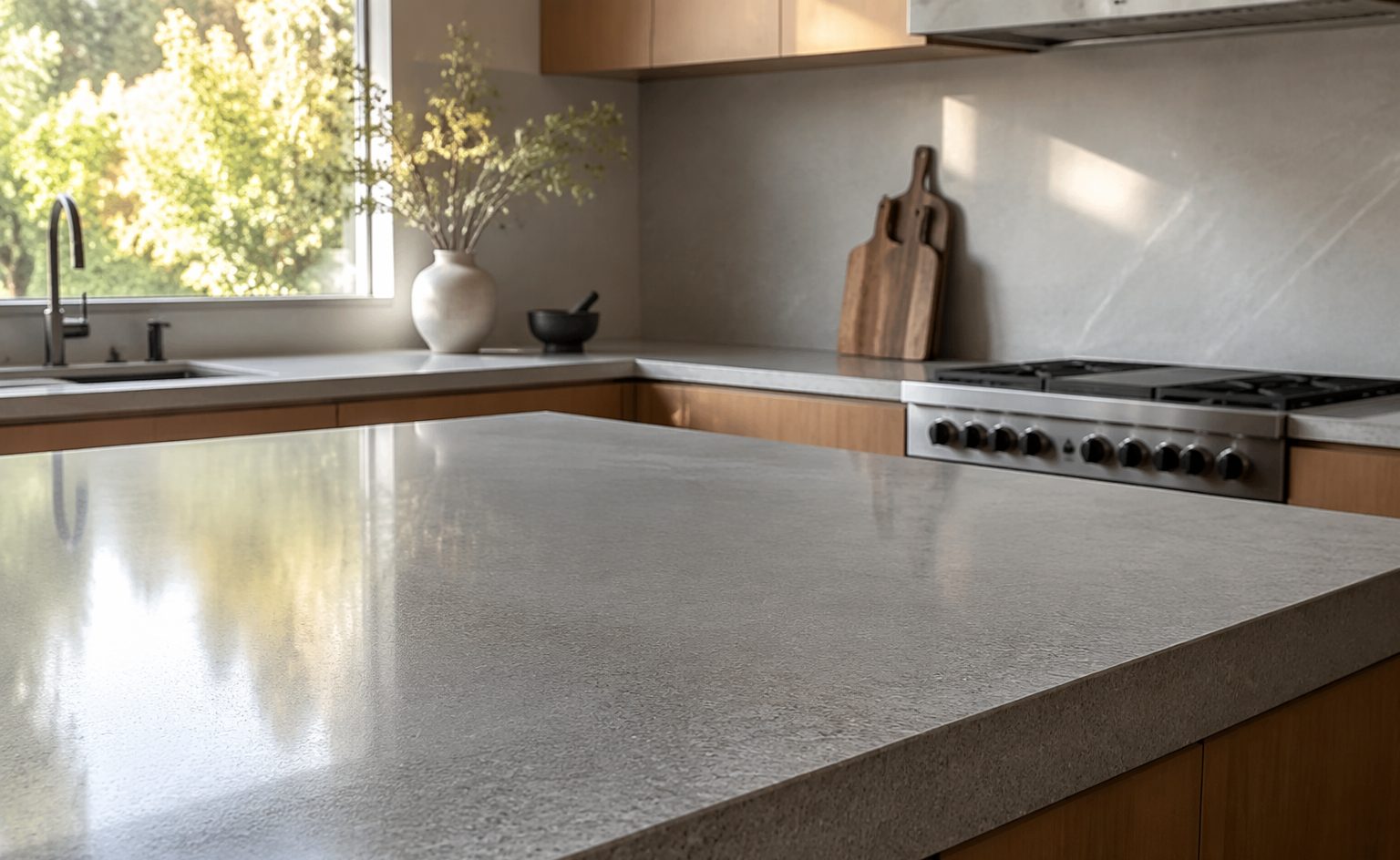
A counter is judged by raking light: morning sun and under-cabinet strips run parallel to the surface and publish every ripple, mound, and dished repair. Building flat is a discipline of thin, even, controlled coats over repairs leveled to the plane, and it is the specific skill that separates counter work from general refinishing. The gallery’s counter photos are taken in exactly that light on purpose.
What Would Stage the Project
Heavy repair scope, a failing previous coating that strips slowly, or a combined project covering counters, sink, and backsplash together can stage the work, and the photo quote says so before booking, never during the day. Standard single-material counter runs are the one-visit format described above, which is the overwhelming majority of what kitchens send.
The Homeowner’s Whole Job
Clear the counters completely, empty the sink cabinet if the crew requests access, plan a day of meal prep on the table, and be present for the morning walkthrough and the evening handoff. No pre-cleaning, no sanding, no product research; the preparation is the product, and the paperwork, care instructions and written terms, arrives at handoff.
Counters and the Rest of the Room
The masking that protects the backsplash and sink is also the argument for renewing them together where they share the counter’s wear: the surfaces are already inside the work zone, the cure is already scheduled, and the combined project returns a kitchen whose surfaces match in age instead of trading one renewed plane against three tired ones.
The Cure and the Curious Household
The 24 hours have one enemy: helpfulness. A family member unloading groceries, a guest setting down a bag, a cat auditing the new surface. The countermeasure is the same one turnover crews use, a sign on the counter edge and one sentence at dinner, and no cure story survives both.
Why the Sequence Is the Product
Everything a counter finish is judged on, its bond, its flatness, its decade, is decided before the final coat exists: in the degreasing, the repairs, the preparation, the cure honored to the hour. The visible finish is the last and least difficult step, which is why comparing companies by their process questions beats comparing them by their photos.
Starting Yours
Send the photo set through our free quote page or call (818) 858-1150, and the reply walks this process as it applies to your counters, number attached. The kitchen-wide case is at kitchen countertop refinishing, and the whole service at countertop refinishing.