
Changing a countertop’s color is a refinishing decision, not a demolition decision: the same renewal that restores a worn surface applies the new color as part of the work, taking a kitchen or vanity out of its decade in place, within days. This post covers where color change works, how the choice gets made well, and the whole-set logic that keeps a room coherent after the counter leaves its era.
Color Is the Complaint More Often Than Wear
Plenty of counters arrive at the quote structurally sound and honestly maintained, guilty only of their palette: the gold-flecked laminate of one decade, the swirled beige cultured marble of another, the forest green that dated the moment it cured. Households replace those counters over color every week in this city, which is solving a finish problem with a construction project. Refinishing changes the color at the finish’s own scale.
Where Color Change Works
The candidacy list is the refinishable list: laminate counters, cultured marble vanity tops, and the other cast and coated surfaces mapped at what countertops can be refinished. If the surface qualifies for renewal, it qualifies for renewal in a new color, the color is not an add-on, it is simply what the new coating system is. Slab stone routes to stone restorers as always, said plainly because honest routing is house policy.
Choosing the Color Well
- Light solids do the most work: they brighten the room, read clean in photos, and date the slowest
- The counter anchors the palette: tub, tile, and walls key off it, so choose the counter first
- Test against the room’s light: the same white reads differently under a window and under bulbs
- Finish options beyond a plain solid exist, and the honest place to settle specifics is the quote conversation, against your actual room
The rule that never misses: when in doubt, calmer and lighter, because bold palettes are how counters end up needing this post twice.
The Whole-Set Logic
A counter that changes color alone can strand the room around it: the tub still wears the old palette, the tile field argues with the new one. Households doing this well decide the room’s palette once and renew the set together, counter, tub, tile as needed, one project, one 24 hour cure window, one coherent result. The bathroom version of that move lives at shower and tub combo reglazing, and the vanity-top specifics at cultured marble countertop and vanity refinishing.
The Kitchen Version
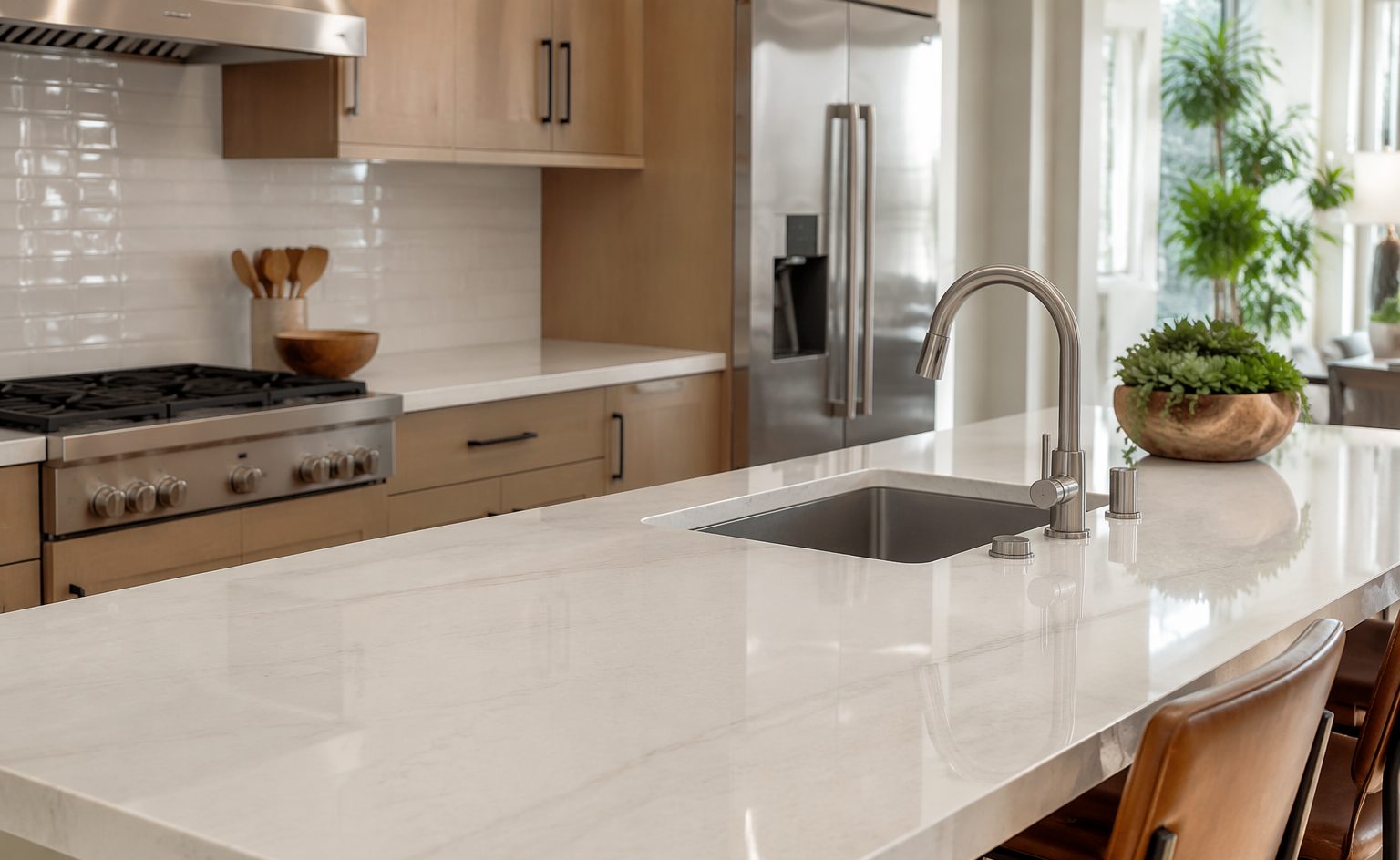
Kitchen counters carry the room’s first impression, and a color update there converts the most dated kitchens for the least scope: the tired laminate goes from its decade to a clean modern read while the cabinets, plumbing, and layout stay exactly where they are. The full kitchen story, including what the renewal does and does not solve, lives at kitchen countertop refinishing.
The Seller’s Version
Pre-sale color updates are the listing photographer’s favorite project: dated counters read as renovation-needed in photos, renewed light counters read as move-in ready, and the work completes on an escrow-friendly calendar. Buyers rarely love a bold choice, which is one more argument for the calm light solid when the house is heading to market.
The Rental Version
Operators standardize the answer: one clean light color across the portfolio, applied as units turn, so every future turnover repairs to the same standard and marketing photos match across listings. Counter color joins tub and tile in the same turnover system, documented at reglazing for property managers.
What a Color Change Cannot Do
Honesty section: the new color cannot fix a failing substrate, water-swollen particleboard under laminate, or structural damage, those route through the assessment in refinishing stained and damaged countertops first. And it cannot change the counter’s shape or layout; when the project is really a remodel, the decision map at refinish versus replace says so without spin.
Why Counter Color Reads Louder Than Any Other Surface
Counters occupy more of a room’s sightline than any other finished surface: they sit at hand height in every photograph, they bounce the room’s light, and they touch every task the room performs. A dated counter color does not read as one dated surface; it dates the whole room around it, which is why color is the complaint that starts most counter conversations even when the surface itself still works perfectly well.
The reverse is equally true, and it is the entire economics of a color change: retire the color and the room advances a decade without a single cabinet moving. Kitchens show the effect at its largest scale, as covered at kitchen countertop refinishing in Los Angeles, because no room photographs its counters more relentlessly than a kitchen does.
The Sample Question and the Light Test
The color decision deserves ten unhurried minutes in the actual room, because counter color lives under that room’s light and no other. Hold candidates flat rather than upright, view them in morning light and again in the evening, and read them against the cabinets and floor that are staying, since the new surface will spend its life mediating between them. Neutrals earn their reputation here: they photograph clean, flatter every dish and appliance set on them, and never argue with a future repaint.
What the finish itself looks and feels like in hand, its sheen, its depth, and the effects available, is a conversation for the quote, where the choices in front of us are real rather than described. What a color change cannot do is already stated plainly above; what it can do is decided in exactly those ten minutes with samples lying flat on the counter.
The Backsplash and the Edge Question
A counter’s color does not stop at the counter: the front edge, the sidesplashes, and the backsplash strip that most tops carry are all part of the same visual surface, and a color change treats them as one plane. The renewal coats the whole assembly together, so the new color turns the corner and runs the splash without a seam or a mismatch line, which is exactly what makes the result read as a new counter rather than a painted one.
The question to settle at the quote is where the color should stop. Tops with a separate tiled backsplash keep the boundary the tile already draws, and the conversation becomes whether the tile stays as a deliberate contrast or joins the project. Tops with an integrated splash carry the new color up the wall as one gesture. Neither answer is wrong; what matters is choosing it on purpose, with the room’s light and the staying elements in view, rather than discovering the boundary after the finish is built. It is a two-minute decision that shapes how finished the finished room looks.
Edges deserve one sentence of their own: the rounded or beveled front edge is the part of the counter hands and hips actually meet, and it takes the new color as part of the same continuous surface. There is no trim piece to match and no seam to hide, which is one of the quiet advantages a coated renewal holds over any surface that arrives in parts.
Can You Refinish Countertops to Look Like Granite?
Yes. Speckled multi-tone finishes give laminate and tile counters the visual read of granite or quartz without the fabrication, the seams, or the demolition. They are chosen from physical samples in your own kitchen light at the quote, because stone-look finishes shift considerably between showroom light and a real room.
Two honest notes on expectations. A speckled finish reads convincingly as stone at conversational distance and in photographs, which is where kitchens are usually judged, and it is a finish rather than a slab up close. And busier speckle patterns hide daily use better than flat solid tones, which is worth knowing if the counter belongs to a working kitchen rather than a staged one. Bring a cabinet door or a paint chip to the quote and colors get decided in minutes instead of guesses.
To see our completed projects and what customers say, read our verified customer reviews and testimonials.
Getting a Color Quote
Photograph the counter from above and the room straight on, name your color direction or ask for guidance, and send it through our free quote page or call (818) 858-1150. The reply confirms candidacy, walks the palette against your actual room, and prices the renewal; the whole service lives at countertop refinishing.