
Rental counters take the hardest use in the portfolio and show it first in listing photos, and countertop refinishing is how Los Angeles operators renew them without demolition, fabrication lead times, or lost vacancy days: one visit per unit, a 24 hour cure, and a kitchen that photographs kept. This is the rental version of the countertop story, written for landlords and property managers, because counters in units live a different life than counters in owner kitchens and the program that manages them is different too.
Why Unit Counters Age the Way They Do
A rental counter is cut on, set with hot pans, cleaned with whatever was cheapest, and never once treated as an investment by the people using it. The result is the standard turnover inventory: knife tracks, burn rings, stains that stopped releasing years ago, dulled patches at the work zones, and edges chipped by a decade of move-ins. All of it is surface-layer wear, which is the whole point: surface wear has a surface answer, and it fits inside the week you already budgeted.
The Kitchen Photo Carries the Listing
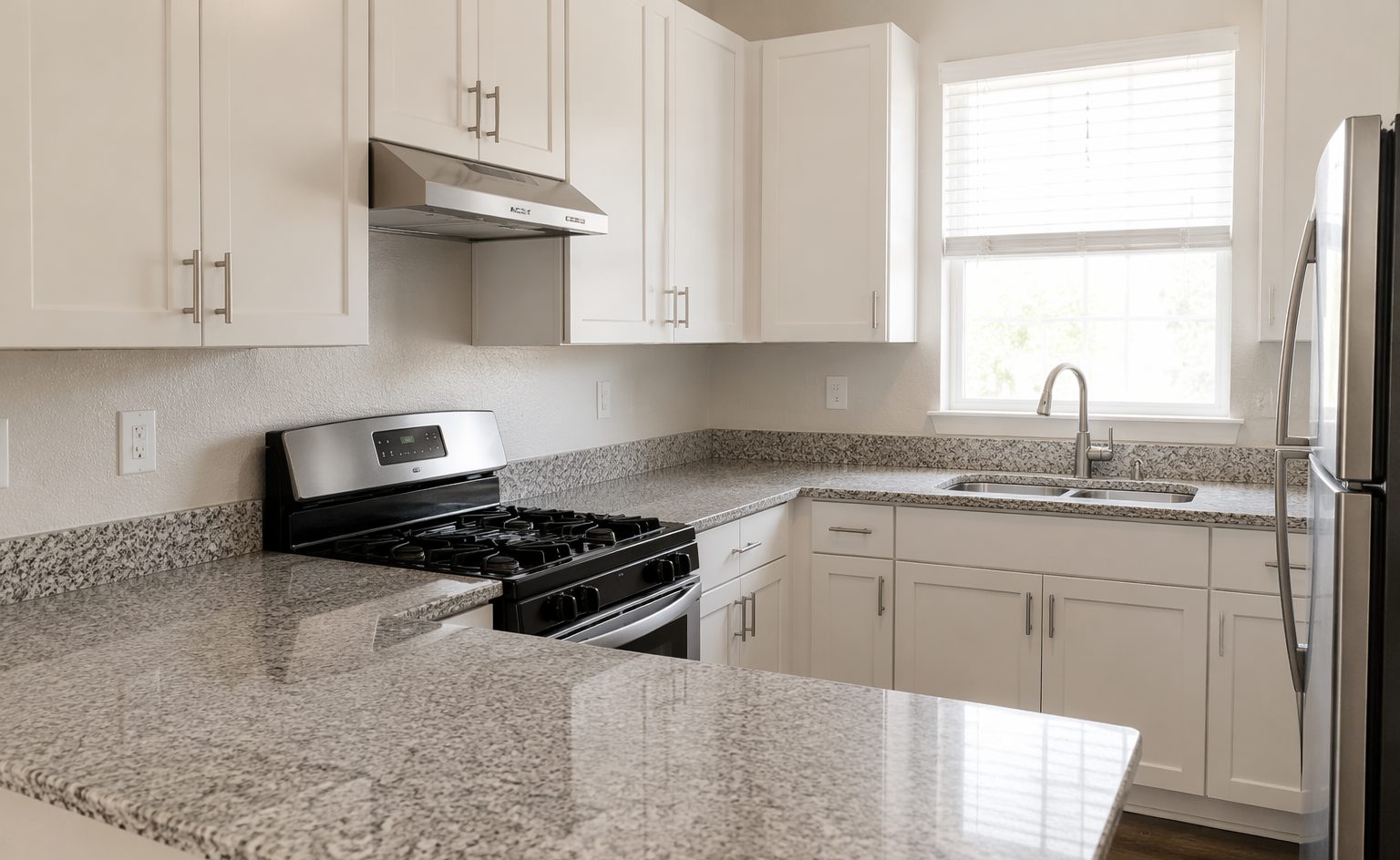
Kitchen photographs anchor every listing, and counters dominate kitchen photographs: they occupy the frame’s middle band, bounce the room’s light, and read instantly as either kept or tired. A worn counter prices itself into the rent conversation before the first showing, and a renewed one resets the room’s whole story for the cost of one turnover line item. Operators who track days-on-market learn this arithmetic quickly.
What the Renewal Does in a Unit
- Stains, burns, and dulled zones ground out and repaired to a true plane
- Chips and edge damage rebuilt before any coating
- A new finish built in controlled coats, in the portfolio’s standard color
- The sink, faucet, and backsplash untouched and connected throughout
The craft sequence, including the flatness standard counters are graded against, is at how countertop refinishing works, and the damage boundaries, what grinds out and what routes to replacement, are covered honestly at refinishing stained and damaged countertops.
The Turnover Week Fit
The renewal books early in the vacancy, the 24 hour cure runs alongside paint and cleaning, and the kitchen photographs before the listing goes live. The week-level playbook is the same one the tub program wrote, at rental turnover bathtub reglazing, and the counter line rides it without adding vacancy days, which is the entire scheduling case against replacement: fabrication lead times do not negotiate with turnover calendars.
Batching Across Units
Buildings repeat their counters the way they repeat their tubs, and repetition is where the program earns its keep: multiple units renewed in coordinated visits share mobilization and scheduling overhead, quotes tighten once the building’s counter stock is known, and the vendor conversation happens once instead of per-unit. Operators already batching tub and sink renewals through turnovers add the counter line inside the same visits more often than not.
Kitchens and Vanities, Unit Edition
Unit kitchens carry the heavy damage and the listing weight, and the kitchen counter story in full is at kitchen countertop refinishing. Unit bathrooms carry the one-piece cultured marble tops that Los Angeles apartment stock is full of, and those renew as one surface, bowl and counter together. A turnover that photographs both rooms usually renews both in the same visit.
The Refinish-or-Replace Call, Portfolio Edition
The decision framework does not change for rentals, but the weights do: vacancy days count double, and replacement’s whole scope, demolition, fabrication, plumbing disconnection, backsplash repair, lands on the turnover calendar where it hurts most. The full comparison, whole scopes on both sides, is at refinish vs replace countertops, and the honest exceptions in it, failed substrates, gut renovations, apply to units exactly as written.
The Standard Color and the Standard Answer
Portfolios standardize counter color for operational reasons: a consistent neutral photographs clean across every unit, matches every cabinet package the buildings carry, and turns every future renewal into a match instead of a decision. Light neutrals also show sun-aging least in the bright units, which matters in a city that builds around windows. Color as a deliberate tool, when a change earns its place, is covered at changing your countertop color.
The Care Card, the Board, and the Trivet
The cheapest counter-durability program in the portfolio costs three items per unit: the one-page care rules, a cutting board, and a trivet, supplied at move-in. Units that get them return long finishes; units left to guess return the burn rings and knife tracks the next turnover will price. The durability story in full, what shortens a counter finish and what stretches one, is at how long a refinished countertop lasts, and a landlord controls more of it than the lease suggests.
The Occupied-Unit Counter Question
Counters fail tenants between leases too, and occupied-unit renewals run the same craft with agreed choreography: the visit scheduled with the tenant, the kitchen masked and protected, and the 24 hour cure planned as a day of counter-free cooking rather than a surprise. The occupied-unit protocol in full, notices, access, and the communication script, lives inside the portfolio system linked below, and the counter line rides it exactly as the tub line does.
The Cultured Marble Building
Whole eras of Los Angeles apartment stock carry the same one-piece cultured marble vanity tops, bowl and counter cast as a single unit, and buildings full of them are the best batching candidates in the portfolio: identical tops, identical wear, identical renewals, quoted once and scheduled in runs. The material’s whole story, what it is, why it yellows, and why replacement punishes this exact surface, is at cultured marble countertop and vanity refinishing, and operators holding buildings from those decades usually recognize their own inventory in the first paragraph.
The batching payoff on these buildings is the strongest in the whole surface program, because the discontinued-parts problem that makes cultured marble replacement painful for a homeowner is multiplied across a building for an operator: there is no matching stock to buy, every replacement becomes custom fabrication, and the vacancy math collapses immediately. Renewal keeps every top in place, in service, and identical to its neighbors, which is what a building full of matching units is supposed to look like, and it is why cultured marble buildings tend to become standing accounts after the first run of tops comes back.
When Replacement Is the Rental Answer
Sometimes it is, and the program stays honest by saying so: a substrate swollen with water damage, a counter that flexes at the sink cutout, or a unit headed into a gut renovation belongs in the replacement column, and the reply from your photos will say so plainly. Everything short of those, which is most of what turnovers present, renews inside the week for a fraction of replacement’s whole scope.
To see our completed projects and what customers say, read our verified customer reviews and testimonials.
The System View
Run as a program, the counter line looks like the rest of the surface program: a standing turnover item, batched where possible, quoted from photos, standardized in color, and warrantied in writing. The portfolio system itself, vendor tests, occupied-unit protocol, warranty-as-workflow, is at bathtub reglazing for property managers, and the counter chapter starts with photographs of your most tired kitchen. Send them through the free quote page or call (818) 858-1150; the whole service picture lives at countertop refinishing.