
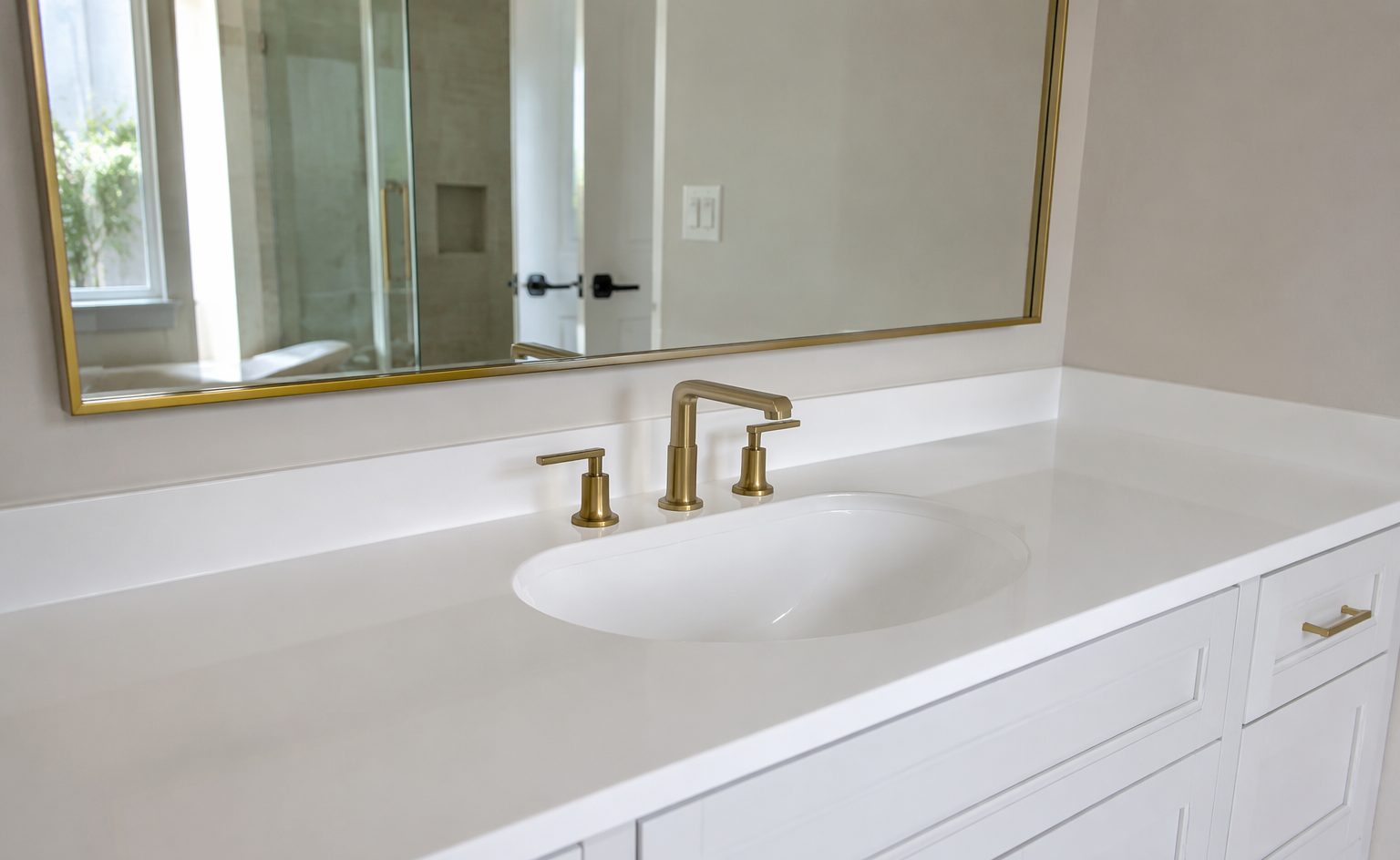
Cultured marble refinishing renews the one-piece vanity tops Los Angeles bathrooms are full of, the cast counter-and-sink units whose gel coat has dulled, yellowed, or worn through, returning gloss and a fresh color to the whole surface as a single piece. This post explains what cultured marble actually is, why it ages the way it does, the one-surface rule that governs its renewal, and where it fits in a bathroom refresh.
What Cultured Marble Actually Is
Cultured marble is a cast blend of crushed mineral and resin, poured as one piece, sink bowl and counter together, and sealed under a factory gel coat that provides the gloss, the color, and the water barrier. It is not slab marble, and that is good news for renewal: the gel coat is a finish layer by design, and when a finish layer ages, refinishing is the native repair. Slab stone is a different world with its own restorers, and the routing rule for it lives in the materials map at what countertops can be refinished.
Why It Dulls, Yellows, and Wears Through
The gel coat carries the whole daily load: cosmetics, heat from styling tools, cleaning chemistry, and years of scrubbing. It dulls where hands and products live, yellows with age and sunlight, and can wear through entirely at the bowl, exposing the duller cast material beneath. None of it is structural, the casting under the coat is usually sound for decades, which is exactly the profile renewal is built for.
The One-Surface Rule
An integrated top refinishes as one piece, bowl and counter together, never bowl-only, because a seam of fresh gloss meeting aged gel coat reads as a patch forever. The same rule governs integrated units in our sink work, stated in the process at how countertop refinishing works, and it is why a cultured marble quote is a whole-top quote by default.
What the Renewal Involves
- Cleaning to bare, sound surface and degreasing the daily chemistry away
- Repairing chips, wear-through zones, and the bowl’s high-mileage ring
- Sanding and preparing the gel coat for adhesion across every plane
- Applying the coating system and curing it to service hardness, 48 hours after the final coat
The work happens in place: plumbing unmoved, backsplash edges masked, the bathroom protected the way every JLF project protects its room.
The Color Conversation, Where Most Projects Start
Cultured marble’s palette dates a bathroom faster than its wear does: the swirled beiges, shell pinks, and gold veining of their decades. Renewal is the moment the top leaves its era, most households choose a clean solid that calms the whole room, and the full color strategy, including how the top’s choice anchors the tub and tile around it, lives at changing a countertop’s color.
The Separate-Basin Boundary
Vanities whose sink is a separate basin set into a counter belong to the sink lane, renewed at bathroom vanity sink reglazing, with the counter around them quoted as its own surface when it needs one. One glance underneath sorts it: a single molded piece with no rim seam is cultured marble territory; a basin with a mounting rim or clips is a sink plus a counter.
Why Replacement Punishes This Exact Surface
Integrated tops are cast to their vanity’s footprint, so replacement means a new top sized to the cabinet, plumbing disconnected and rebuilt, backsplash edges disturbed, and often a cabinet conversation the project never asked for. Renewal treats the actual problem, the finish, at the finish’s scale, which is the whole decision framework at refinish versus replace countertops.
The Whole-Bathroom Moment
The vanity top rarely ages alone: the tub wears the same years, the tile field around it too, and households routinely renew the set in one project, one mobilization, one palette, one cure window, a bathroom that reads renovated at surface-work scope. The room-level logic lives at shower and tub combo reglazing.
Care That Keeps the New Gel Story
The renewed top follows the house rules: non-abrasive cleaner, soft cloth, no scouring powders, heat set on a folded towel rather than bare surface, and drips fixed early. The complete doctrine lives at reglazing aftercare, and the first 48 hours of cure are the only rule that cannot be made up later.
Why Los Angeles Has So Much Cultured Marble
Cultured marble had its construction heyday in the apartment, condo, and tract-home building runs of the 1960s through the 1980s, and Los Angeles built enormously in exactly those decades, which is why so many vanities across the city carry the same one-piece top with the same integrated bowl and the same slow yellowing. The material was chosen for speed and seamlessness, and it delivered both; the gel coat simply was not designed to outlast the building.
That history also explains the matching problem: the makers, molds, and color runs behind these tops are long gone, so a replacement search for a discontinued size or bowl placement often dead-ends into custom fabrication. Refinishing sidesteps the entire hunt, because the top you own already fits the cabinet, the plumbing, and the room, and only its surface is asking for anything.
The One-Visit Rhythm for a Vanity Top
The renewal runs as a single crew visit: masking, the mechanical preparation that gives the new finish its grip, repair of chips and worn-through spots, and the controlled build of the new surface, followed by a 48 hour cure after the final coat before the top returns to service. The faucet stays mounted, the plumbing stays closed, and the cabinet below never knows anything happened.
The step-by-step craft, including why flatness and preparation are graded harder on counters than anywhere else, is walked at how countertop refinishing works. Compare that rhythm against demolition, disposal, fabrication lead times, and reinstallation, and the one-piece top’s replacement story explains on its own why this surface is refinishing’s most loyal customer.
Chips, Wear-Throughs, and What Repair Restores
Most cultured marble tops arrive at the decision with more than dullness: a chip at the bowl rim where a bottle landed, an edge ding from a move, and the classic wear-through, the pale rough patch at the bottom of the bowl where decades of cleaning finally rubbed past the gel coat into the cast material beneath. All of it is surface-layer damage, and repair comes before coating, always: chips are filled and shaped back to the surface line, wear-throughs are rebuilt, and the whole plane is trued before the new finish is built over it.
What repair cannot do is also worth stating plainly. A top with structural cracks that flex under hand pressure, or one whose bowl has been broken through, is a candidate for assessment rather than a promise, and we say so from the photographs. Everything short of that, which is the overwhelming majority of what Los Angeles vanities present, is the ordinary jurisdiction of the renewal.
To see our completed projects and verified customer reviews, read verified Marble Refinishing Los Countertop Vanity Cultured Angeles customer reviews and testimonials.
Quoting Your Top
Photograph the vanity from above, one straight-on shot, and a close-up of the worst wear, and send the set through our free quote page or call (818) 858-1150 with your color direction if you have one. The reply confirms the surface, prices the whole-top renewal, and shows the bundle if the tub or tile should ride along; the pillar for the whole service is at countertop refinishing.